

Publications

Selected Bertelsmann Stiftung publications on the EU Multiannual Financial Framework and budget negotiations. 

More Publications

Fund or Fumble – How to Make the European Competitiveness Fund Work

Lucas Carvalho, Anna Heckhausen · 2026

Fund or Fumble – How to Make the European Competitiveness Fund Work

The proposed European Competitiveness Fund (ECF) represents a material shift in both the design and governance of EU industrial policy. By consolidating fragmented instruments, concentrating resources within strategic policy windows, reinforcing annual work programmes and bringing grants and financial instruments together under a single framework, the ECF could become the anchor of a more coherent industrial policy at European level. Yet crucial elements of the ECF proposal remain politically contested. Fault lines are emerging over the fund’s overall scale, the balance between merit-based allocation and geographical distribution, the depth of strategic prioritisation and the scope of European preference provisions. At the same time, critical governance interfaces – notably between Horizon and the ECF, and between grants and financial instruments – require clearer definition. The ECF must also strike a credible balance between flexibility and effective oversight. Against the backdrop of intensifying negotiations, this paper assesses the European Commission’s proposal and advances recommendations to ensure that the ECF evolves into a genuinely transformative instrument of industrial policy rather than a rebranded consolidation of existing funding streams.
Access online
What’s Next for Global Europe? Unpacking the MFF Proposal

Anna Heckhausen, Katharina Staudte · 2026

What’s Next for Global Europe? Unpacking the MFF Proposal

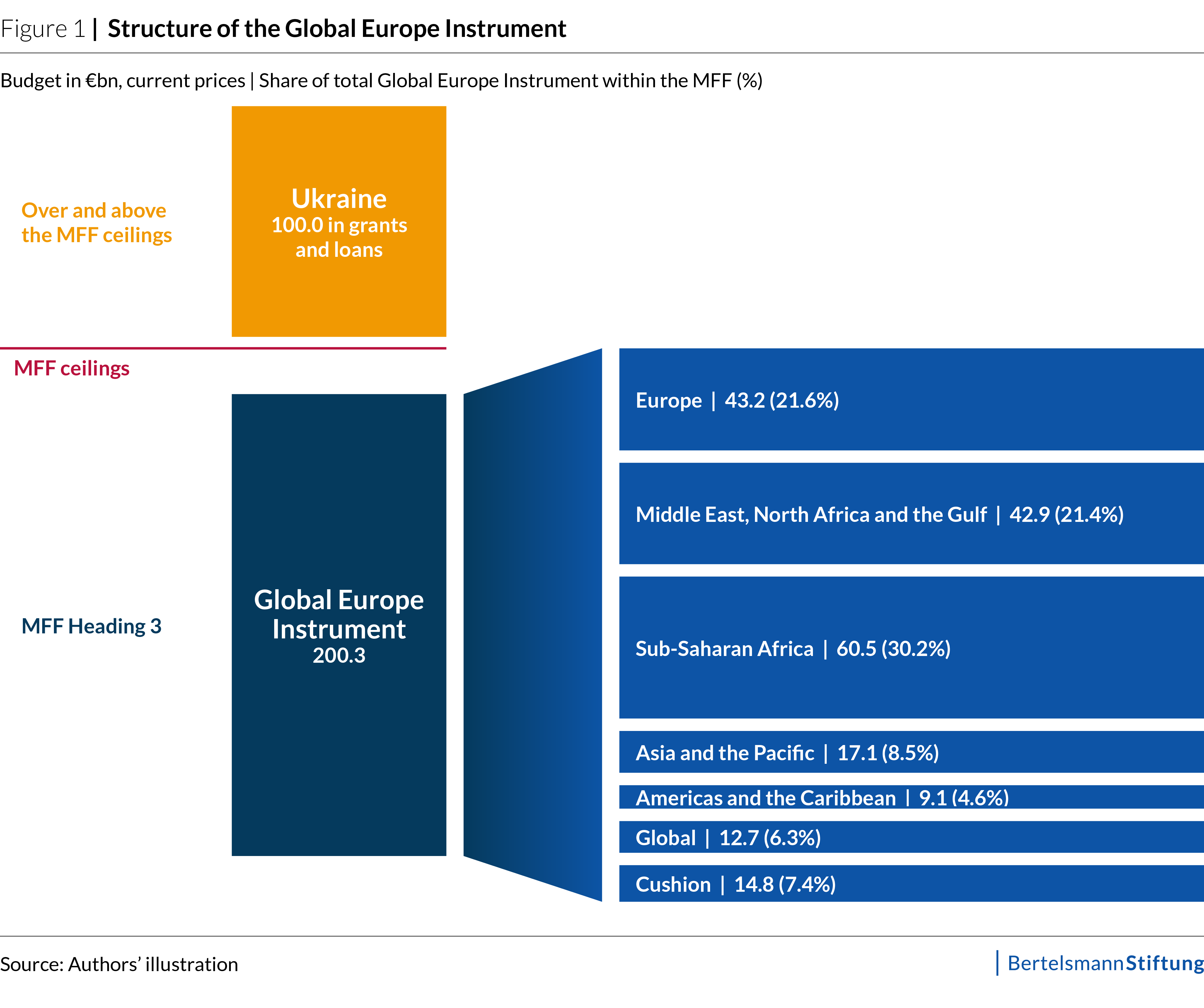
The Commission’s proposed Global Europe Instrument (GEI) represents a major rethink of how the EU will fund external action in the next long-term budget. It consolidates existing programmes under a single umbrella envelope, reduces rigid spending targets and expands built-in flexibility. The aim is clear: to make limited resources go further and to allow the EU to adjust its external programmes more quickly as geopolitical conditions evolve. At the same time, it raises questions about the balance between flexibility and predictability, as well as governance and evaluation – all of which will be central to the negotiations ahead.

Access online
Cohesion Policy in National Envelopes: How to Integrate Partnership

Andrey Demidov, Thomas Schwab · 2025

Cohesion Policy in National Envelopes: How to Integrate Partnership

Future EU Cohesion Policy is likely to hand more decision-making over to member states with the European Commission’s plans of merging multiple funds delivered to member states by national envelopes. Such a delivery model for Cohesion Policy will curtail the involvement of subnational and civil society actors. This, in turn, can disrupt the flow of information and expertise provided by these actors. As a result, effective and impactful Cohesion Policy is at risk.

Access online